Beverage Supplier Malaysia: The Wholesale Buying Guide for F&B Businesses (2026)
DC
Derreck Chia Swee Kuan
Founder, Happypopper International Sdn Bhd · In F&B supply since 2013
Last updated: 12 August 2026
TL;DR: A beverage supplier in Malaysia should give you wholesale prices on syrups, powders, tea, boba, and toppings, plus the machines and packaging to serve them, from one account. Wholesale pricing depends on MOQ, and factory-direct supply beats distributor pricing by cutting out middle layers. Before you commit, confirm halal status per product, warranty scope, and delivery channel. This guide covers all of it, from 13 years inside F&B supply.
Small F&B buyers in Malaysia pay a quiet penalty. When we entered F&B supply in 2013, we experienced it ourselves: small orders quoted 30 to 50 percent above what large buyers pay, no bargaining power, and punishing terms.
Most drink stall, kiosk, and cafe owners also juggle 3 to 4 separate suppliers. One for the machine, one for ingredients, one for cups and packaging. Every extra supplier means another delivery fee, another minimum order, and another person to chase when something goes wrong.
It matters because the market you are fighting in is large and crowded. Malaysia's food and beverage services sector generated RM99.0 billion in gross output across 136,453 establishments, according to the Department of Statistics Malaysia's Economic Census 2023. Your supplier costs decide whether your margin survives that competition.
This guide explains what a beverage supplier in Malaysia actually covers, how beverage wholesale really works, why factory-direct pricing beats distributor pricing, and the 7 checks we would run before trusting any drink supplier with our own money.
What Does a Beverage Supplier in Malaysia Actually Supply?
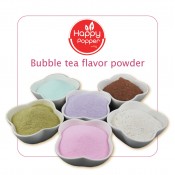
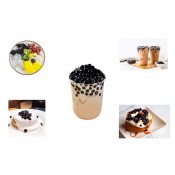
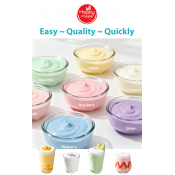
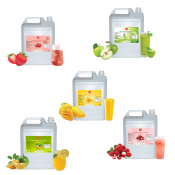
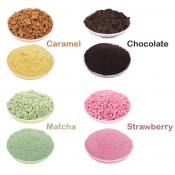
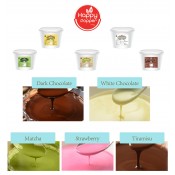
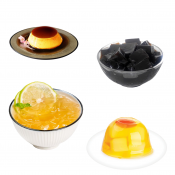
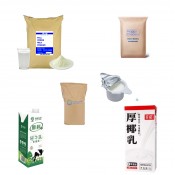
A beverage supplier in Malaysia supplies the ingredients behind your drinks menu: flavour syrups, tea leaves, beverage and dessert powders, boba pearls, fructose syrup, concentrated fruit juices, creamers, milk foam powders, and toppings. A complete supplier also carries the paper cups, straws, sealer film, and machines needed to prepare and serve those drinks.
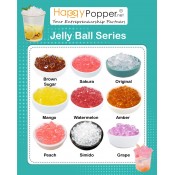
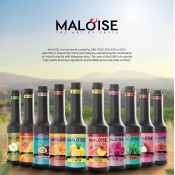
At Happypopper, our beverage supplier range in Malaysia covers 814 wholesale listings in this one category. That includes recognised brand lines such as Monin syrups (58 listings) and Maloise syrups (21 listings), alongside tea leaf, tapioca pearls, popping boba, jelly toppings, and concentrated juices in bulk trade formats.
The practical takeaway: before you sign up with any supplier, list every item your menu needs, from syrup down to straws. Then count how many of those items one account can cover. Fewer accounts means fewer deliveries, fewer minimums, and fewer points of failure.
How Does Beverage Wholesale Work in Malaysia?
Beverage wholesale in Malaysia works on minimum order quantities and bulk trade formats, such as 1kg packs and cartons of 12 to 30 units. Wholesale price applies once you meet the MOQ for that product, and MOQ varies per item. A single retail purchase does not get wholesale price, no matter what a listing page implies.
We say this plainly because it is the part of wholesale most first-time buyers misunderstand. At Happypopper, MOQ is confirmed per product in live chat before payment, displayed prices are Ex Tax, and prices are subject to change. Any supplier who cannot tell you the MOQ, pack format, and stock position before you pay is guessing.
A serious wholesale account should also protect you on supply, not just price. Two services worth asking any supplier about:
Price locks on pre-orders. Our pre-order terms lock price and timeline for 3 months against a 50 percent deposit, so a factory re-order does not surprise you with a new price.
Inventory storage. Regular buyers can use free inventory storage, so bulk savings do not have to compete with your shop's storage space.
Volume is what makes wholesale work, on both sides of the counter. We currently handle 7,512 orders per month, and that pooled volume is what lets small buyers access pricing normally reserved for large accounts.
7,512orders per month
814beverage listings
4.8 ★610 Google reviews
Since 2013in F&B supply
Beverage Distributor vs Supplier vs Factory-Direct: What Is the Difference?
A beverage distributor in Malaysia buys from manufacturers and resells to shops with a markup. A general supplier may source through those same distributors. Factory-direct supply skips the middle layers entirely, which is why the same product can sit 50 to 70 percent below retail price and 30 to 50 percent below other online sellers.
Beverage distributor
Marketplace seller (e.g. Shopee)
Factory-direct supplier
Layers between factory and you
Manufacturer, then distributor, then you
Factory, then reseller, then platform, then you
Factory, then you
Extra costs built into price
Distributor markup
Reseller markup plus platform fees
None stated
Typical price position
Retail or near-retail
30 to 50 percent above factory-direct
50 to 70 percent below retail
Who answers when something breaks
Varies by distributor
The reseller, via the platform
The supplier's own factory and repair team
Every layer between the factory and your counter adds cost without adding value to your customer. That is the whole argument. We explain the model in full on our why our prices are so low page: same factory goods, shorter chain, no distributor markup and no marketplace platform fees.
The mechanism behind it is collective purchasing. Individually, a kiosk ordering a few cartons has no bargaining power. Pooled together with thousands of other small orders, that demand negotiates with factories as one large account. We run this model across 82 suppliers, of which 48 are internally certified as SME-Friendly Partners, and we blacklist factories that treat small buyers unfairly. Since 2024, 21 price disputes have been resolved through our internal Fair Pricing Arbitration. By our own company tracking, RM8.6 million or more in cumulative procurement savings has been passed to partners (unaudited figure).
The most common question we get is whether this is really cheaper than Shopee. Yes, usually by a wide margin, because marketplace sellers carry platform fees and reseller markups that factory-direct supply does not. The fair test: compare the same product code, not just a similar-looking photo.
How to Choose a Drink Supplier in Malaysia: 7 Checks From 13 Years in F&B Supply
We published a broader guide on how to choose a reliable food supplier, but for drinks specifically, these are the 7 checks we would run. Each one comes from problems our team handles every week.
Confirm halal status per product, not per supplier. Halal-certified lines are available on selected products, and some lines are made in Malaysia while others are made in China. Never accept a blanket claim. Confirm the halal status of each specific product before ordering.
Ask for the warranty tier and scope in writing before buying any machine. Warranty runs 6 months, 1 year, or 2 years depending on the machine, and some home-use-grade machines carry none. Coverage is narrower than most buyers assume: electric machines cover the heater and wiring only, gas machines cover the ignition valve only. Our after-sales team explains warranty scope as the first step of every case, because almost every customer assumes full coverage.
Check the delivery channel for your area. In KL and Selangor we run our own routing, with each area's route running weekly. West Malaysia courier delivery typically takes 2 to 3 days. East Malaysia sea freight typically runs 2 weeks and can take up to a month. Ask for your area's next slot instead of trusting a vague promise.
Ask what happens when a machine breaks. A broken blender or milk tea machine stops your counter. Under warranty, our technician collects the machine, repairs it at our Kapar factory, and returns it. And learn from the single most common breakdown our repair bench sees: a high-pressure gas regulator fitted to a machine built for low pressure. Match the regulator to the machine, always.
Verify the supplier physically exists. A registration number you can check (ours is 202201043064), a factory address you can visit, and a review trail you can read. We hold 4.8 stars across 610 Google reviews, and the most-mentioned themes are friendly staff and fast response.
Test whether they will talk you down from over-buying. An honest supplier sometimes recommends the smaller unit. We regularly tell buyers that our RM300-class ice cream package is a party kit, not a business tool, and that business-grade entry starts at RM1,399. A supplier who upsells everything is selling; a supplier who right-sizes is advising.
Count how much of your operation one account covers. Machines, ingredients, and packaging from one supplier means one delivery, one contact, and one accountable party when something goes wrong.
Can You Make Specialty and Soft Drinks Cheaper Than Buying Ready-Made?
For many stalls and cafes, yes. Preparing drinks in-house from wholesale concentrates, syrups, powders, and fructose usually costs less per cup than reselling ready-made bottled stock, because you buy ingredients at bulk prices and control every portion. The trade-off is prep work and a one-time equipment cost.
The ingredient side covers concentrated fruit juices, flavour syrups, brown sugar syrup, tea leaf, and milk foam powders, plus canned toppings and canned lines for operators without chiller space. That last point matters more than most buyers realise: canned stock's real value for a small operator is storage without a chiller, not just price.
On the equipment side, a beverage counter typically runs on a small set of commercial machines: a blender or milk shaker, a fructose dispenser, a water boiler or steam frother, an ice machine, a soda bubble water maker for sparkling drinks, and a cup sealer with matching PP cups and sealer film. Buying these where you buy ingredients keeps specs matched and spare parts available from the same factory.
If you are starting from zero, this is exactly the mismatch problem that catches first-timers: buying the wrong combination of equipment and only finding out after committing. It is why we bundle machine, materials, tools, and operational teaching into start business packages, with a booked 2 to 3 hour training session at our Kapar premises covering machine operation and A-to-Z preparation of the product.
What One F&B Supplier Account Should Cover
The strongest reason to consolidate with one f&b supplier in Malaysia is not any single discount. It is the compound effect of one account covering machines, ingredients, and packaging together.
"We are not just selling machines or ingredients. We provide a one-stop solution built around the needs of entrepreneurs."
That philosophy is the reason our range spans 877+ commercial machines across 60 categories, 2,000+ wholesale food materials across 8 regional cuisines, packaging, stainless steel equipment, and spare parts, all from one factory-direct supplier account.
The proof we trust most is behaviour, not testimonials: package customers keep returning to restock ingredients, which tells us their stalls keep trading. Where customers have spoken for themselves, we quote them as their own claims. One school canteen customer told us their business increased around 30 percent using the equipment, and a supermarket kiosk customer told us their small package start gives them stable extra income.
The Bottom Line
Choosing a beverage supplier in Malaysia comes down to three things. Confirm the real wholesale terms: MOQ, pack format, Ex Tax pricing, and stock, per product. Prefer factory-direct supply over distributor chains, because every removed layer is margin returned to you. And run the 7 checks above before committing, especially halal status per product and warranty scope per machine.
Ready to compare real numbers?
Our in-house team confirms specification, price, stock, origin, halal status, and MOQ for wholesale pricing before you pay a single ringgit. Self-pickup at our Kapar, Klang factory is always free.
Who stands behind this guide: Happypopper International Sdn Bhd (registration 202201043064 / 1488761-D), Lot 40, Jalan Meru Indah 20, Kapar, Klang, Selangor. Phone 03-3345 6349. Every price on our site carries a product code, pack format, and Ex Tax label, with live chat as the final confirmation. Returns are accepted within 7 days in resaleable condition; non-quality-issue returns are at the buyer's freight cost. Warranty terms are stated per machine before you order.
Frequently Asked Questions
Is a beverage supplier cheaper than buying from Shopee?
Usually, yes, and often by a wide margin. Factory-direct suppliers carry no marketplace platform fees and no reseller markup, which is why prices can sit 30 to 50 percent below other online sellers. To compare fairly, check the same product code on both platforms rather than a similar-looking listing.
Are wholesale beverages in Malaysia halal?
Halal-certified lines are available on selected products only, and some lines are made in Malaysia while others are made in China. No honest supplier gives a blanket answer. Confirm the halal status of the specific product in live chat before ordering.
Is there a minimum order for beverage wholesale in Malaysia?
MOQ varies by product: some items carry a larger MOQ, some smaller. Single retail purchases are not charged at wholesale price. Confirm the MOQ for your product in live chat before ordering. On pre-orders, machines usually have no MOQ while ingredients usually do.
How long does beverage delivery take in Malaysia?
It depends on your channel. KL and Selangor run on weekly own-route deliveries per area, free on single orders from RM150. West Malaysia courier typically takes 2 to 3 days. East Malaysia sea freight typically runs 2 weeks and can take up to a month. Ask live chat for your area's next slot.
What warranty do commercial beverage machines have?
Warranty is 6 months, 1 year, or 2 years depending on the machine, and some home-use-grade machines have none. Electric machines cover the heater and wiring only; gas machines cover the ignition valve only. Confirm the tier and scope for your exact model before ordering.
How do I start a drinks business in Malaysia?
Start with a matched set: one machine, the ingredients it uses, and the packaging to serve, sized to your stall or kiosk. Bundled start business packages cover machine, materials, and tools, plus a booked 2 to 3 hour training session at our Kapar premises covering machine operation and A-to-Z preparation of the product.